

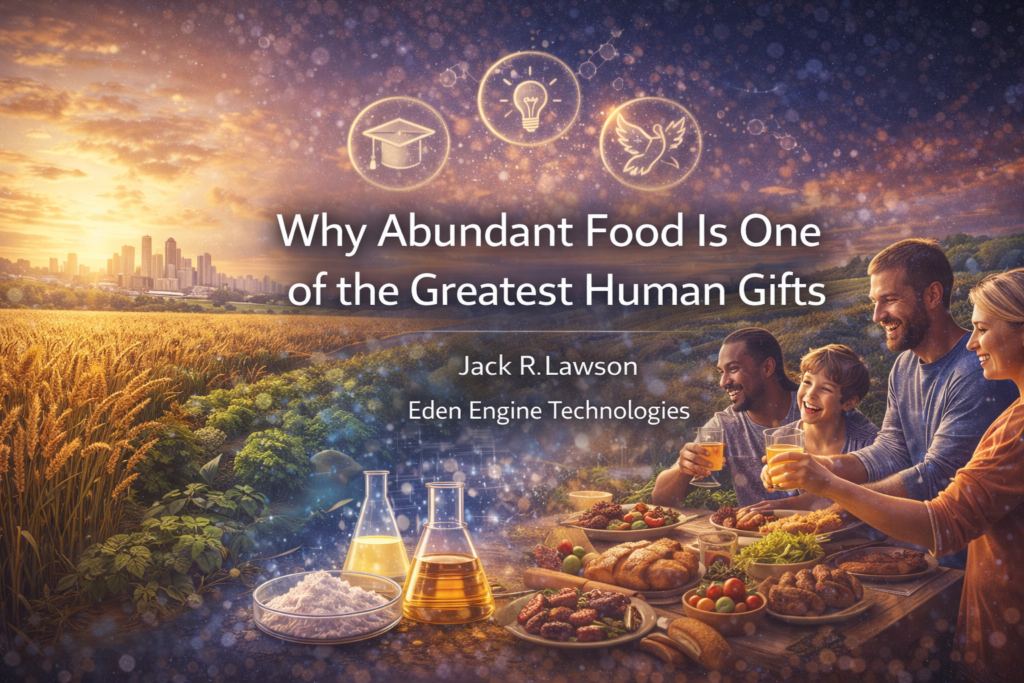
Abundant food is easy to take for granted.
For most of human history, it was rare.
The difference between scarcity and surplus has shaped civilizations, determined political stability, driven migration, and defined whether societies flourished or collapsed. When food is scarce, everything becomes fragile. When food is abundant, everything becomes possible.
Food is not just fuel.
It is the foundation of human potential.
Scarcity Shrinks the Human Horizon
In environments defined by food insecurity, energy is consumed by survival.
Families plan around harvest cycles. Communities brace for drought. Nations depend on unstable supply chains. Innovation slows because attention is diverted to meeting basic needs.
History is full of examples where crop failure led to unrest, migration, or collapse. Scarcity narrows decision making. It increases conflict. It reduces long term planning.
When calories are uncertain, civilization becomes reactive.
Abundance Expands Civilization
Abundant food changes the psychological structure of society.
When nutrition is stable:
- Children grow and learn without chronic stress
- Parents plan for the future
- Communities invest in infrastructure
- Innovation accelerates
- Conflict decreases
Food security does not solve every problem, but it removes one of the oldest and most destabilizing pressures humans face.
Surplus calories create room for science, art, exploration, and cooperation.
The agricultural revolution allowed cities to form.
Industrial agriculture allowed populations to scale.
The next phase of abundance will determine what comes next.
Abundance Is More Than Volume
True abundance is not just producing more.
It is producing reliably.
It is resilience against drought, flood, geopolitical disruption, and supply chain failure. It is the ability to feed populations regardless of regional volatility.
Modern agriculture has achieved extraordinary productivity, but it is still exposed to climate variability, land constraints, water scarcity, and fragile logistics networks.
A resilient future requires layered systems.
It requires food infrastructure that is not entirely dependent on soil, seasons, and geography.
Abundance must become programmable.
The Moral Dimension of Surplus
When food is scarce, distribution becomes zero sum.
When food is abundant, cooperation becomes easier.
One of the greatest humanitarian achievements of the last century has been the reduction of famine in many parts of the world through improved agriculture, logistics, and storage.
But billions still live near the edge of food insecurity.
Abundant food is not a luxury. It is a stabilizer of dignity.
The ability to nourish populations predictably reduces desperation, lowers instability, and increases opportunity.
It changes what societies argue about.
Abundance as Infrastructure
The next step in human development is not simply growing more crops.
It is building food systems that can operate:
- Close to cities
- In arid regions
- In climate stressed environments
- In remote communities
- In future space habitats
Electricity is infrastructure.
Water systems are infrastructure.
Food must be treated the same way.
When calories become locally producible through controlled systems, resilience increases dramatically.
That is not about replacing farms.
It is about strengthening civilization.
Psychological Freedom
There is a quiet psychological shift that happens when food is reliably available.
Planning horizons extend.
Risk tolerance increases.
People innovate because survival is not the daily question.
Throughout history, breakthroughs in science and culture have often followed periods of agricultural stability.
Abundance frees cognitive bandwidth.
It allows societies to think beyond the next harvest.
The Gift That Multiplies
Unlike many resources, food abundance multiplies human capacity.
Well nourished children learn better.
Healthy adults work and create more effectively.
Stable communities build stronger institutions.
Abundant food amplifies every other human system.
Energy, education, technology, governance, and culture all benefit from nutritional security.
It is the quiet multiplier of progress.
The Future of Abundance
We are entering an era where food production can evolve beyond traditional constraints.
Advanced biotechnology, automation, artificial intelligence, and modular production systems are creating pathways to produce foundational nutrition more reliably and closer to demand.
That does not eliminate agriculture.
It strengthens the entire system.
A layered approach to food security makes global civilization less brittle.
The more resilient our food infrastructure becomes, the more stable and prosperous humanity can be.
Why It Matters
Food abundance is not just an economic milestone.
It is a civilizational threshold.
It reduces conflict.
It expands opportunity.
It stabilizes populations.
It allows human intelligence to focus on creation rather than survival.
Abundant food is one of the greatest human gifts because it underwrites everything else.
When humanity secures calories at scale and with resilience, it unlocks the next stage of development.
Civilization stands on many pillars.
Food is the first one.
Jack R Lawson, Founder, Eden Engine Technologies