

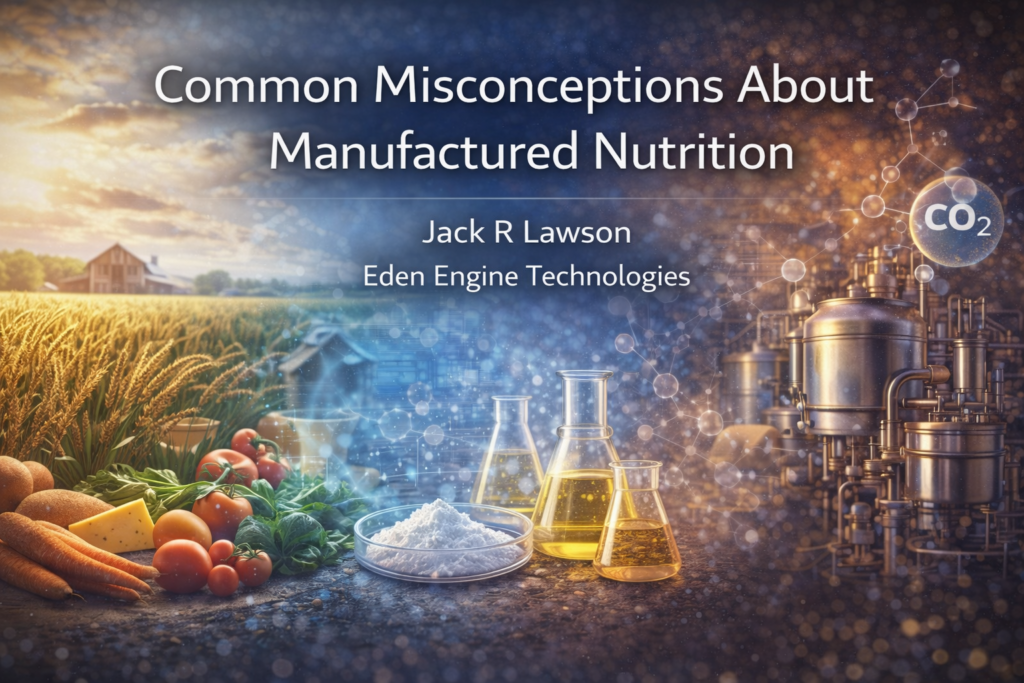
The phrase manufactured nutrition can trigger an instant reaction.
For some people it sounds exciting. For others it sounds suspicious. It can feel like the kind of idea that belongs in a futuristic sales pitch rather than in a serious conversation about food.
That reaction is understandable, because most of us grew up with a simple mental model.
Food comes from farms.
But the future of food will include systems that produce foundational nutrition through controlled processes, closer to where people live, with fewer dependencies on land, weather, and long supply chains.
To talk about that future clearly, we need to remove the fog around the most common misconceptions.
Misconception 1: Manufactured Nutrition Is Fake Food
The word manufactured makes people picture something artificial, like a substitute that only looks like food.
But nutrition is chemistry.
Carbohydrates, fats, and proteins are molecules. Vitamins and minerals are molecules. Your body does not metabolize stories. It metabolizes structure.
If a molecule is chemically identical and meets purity standards, it is not fake. It is the same molecule.
The difference is not the nutrition.
The difference is the system that produces it.
Misconception 2: If It Is Made in a Facility, It Must Be Less Safe
Many people assume that a factory automatically means lower safety and lower quality.
In reality, many of the safest consumables in the world are made in controlled facilities for the simple reason that control reduces uncertainty.
Modern food manufacturing and biotech production can tightly manage:
- Input quality
- Contamination risk
- Purity standards
- Batch testing
- Traceability
Traditional agriculture interacts with soil variability, water contamination, pests, runoff, and long transport chains.
A closed loop system can often reduce those risks rather than increase them.
Misconception 3: Manufactured Nutrition Has No Regulation
New food production methods do not exist outside oversight.
Regulators do not approve concepts. They approve evidence.
Manufactured ingredients are evaluated through frameworks that focus on:
- Identity, what the ingredient is
- Purity, what is in it and what is not
- Contaminants, what could ride along unintentionally
- Consistency, whether it can be produced reliably
- Intended use, how people will consume it
If anything, engineered nutrition tends to attract more scrutiny than traditional inputs because it is new and because the standards for introducing new ingredients are strict.
Misconception 4: This Means Replacing Farmers
This is one of the most emotionally loaded misconceptions.
But the future is not one system replacing another.
The future is layered.
Manufactured nutrition is not primarily about eliminating agriculture. It is about stabilizing food supply when agriculture is stressed and about expanding production into places where agriculture struggles.
It can reduce pressure on land, reduce reliance on fragile supply chains, and open new options for resilience.
In many scenarios, agriculture benefits when certain calories can be produced with less land and water intensity, allowing more land to return to ecological health or higher value crops.
Misconception 5: This Is Only About Climate
Climate is part of the story, but it is not the whole story.
Manufactured nutrition also addresses:
- Food security during disruptions
- Urban population growth
- Water scarcity
- Supply chain volatility
- Geopolitical risk
Even if climate were stable, the world would still benefit from food systems that can operate locally, predictably, and continuously.
Misconception 6: It Must Be Energy Wasteful
People often assume that making nutrition in a facility must be less efficient than growing crops in sunlight.
But the real comparison is not a single plant under perfect conditions.
The real comparison is the full system.
Modern agriculture includes land clearing, irrigation, fertilizer production, mechanized harvesting, processing, refrigeration, and long distance transport.
A carbon to nutrition system can be powered by electricity, can operate near demand centers, and can be designed to recycle inputs.
Efficiency is not a slogan.
It is a lifecycle measurement.
Misconception 7: Manufactured Nutrition Means Ultra Processed Food
Ultra processed is a label that describes food products that are heavily formulated, often engineered for taste and shelf life, and often high in additives.
Manufactured nutrition is different.
It refers to how foundational nutrition molecules are produced, not how they are packaged into consumer products.
A sugar molecule is not ultra processed.
A vitamin molecule is not ultra processed.
The processing level of a final product is a separate decision made downstream.
Misconception 8: This Is Science Fiction
The idea feels futuristic because it challenges a deep assumption, that food must come from soil.
But the underlying technologies already exist in many forms.
Biomanufacturing already produces:
- Enzymes
- Vitamins
- Amino acids
- Organic acids
- Industrial biomolecules
Manufactured nutrition extends that capability to the foundational layers of calories and inputs.
The future is not a leap.
It is a build.
The Reframe That Matters
Manufactured nutrition is not an argument against nature.
It is a tool for stability.
It is a way to create food resilience in a world where weather patterns shift, supply chains break, and cities keep growing.
The goal is not to make food less human.
The goal is to make civilization less fragile.
If we want a future where people are fed regardless of volatility, we will need food systems that can be deployed where people are, powered by electricity, and supported by modern monitoring and quality control.
The conversation will move faster when we stop arguing over the word manufactured and start evaluating systems by what matters.
Safety.
Purity.
Resilience.
And the ability to keep people alive when the world gets unpredictable.
Jack R Lawson, Founder, Eden Engine Technologies