
Small Evidence Beats Big Claims
Carbon-to-food technology is a serious idea, but serious ideas do not become credible because they sound large. They become credible when a team can define the question, control the inputs, measure the outputs, and repeat the work under conditions that other technical reviewers can understand.
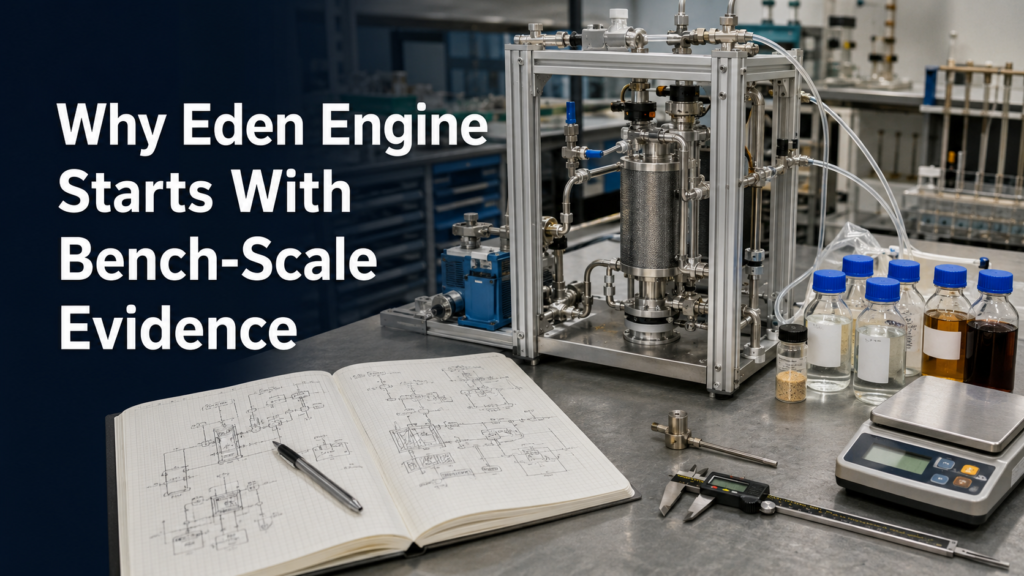
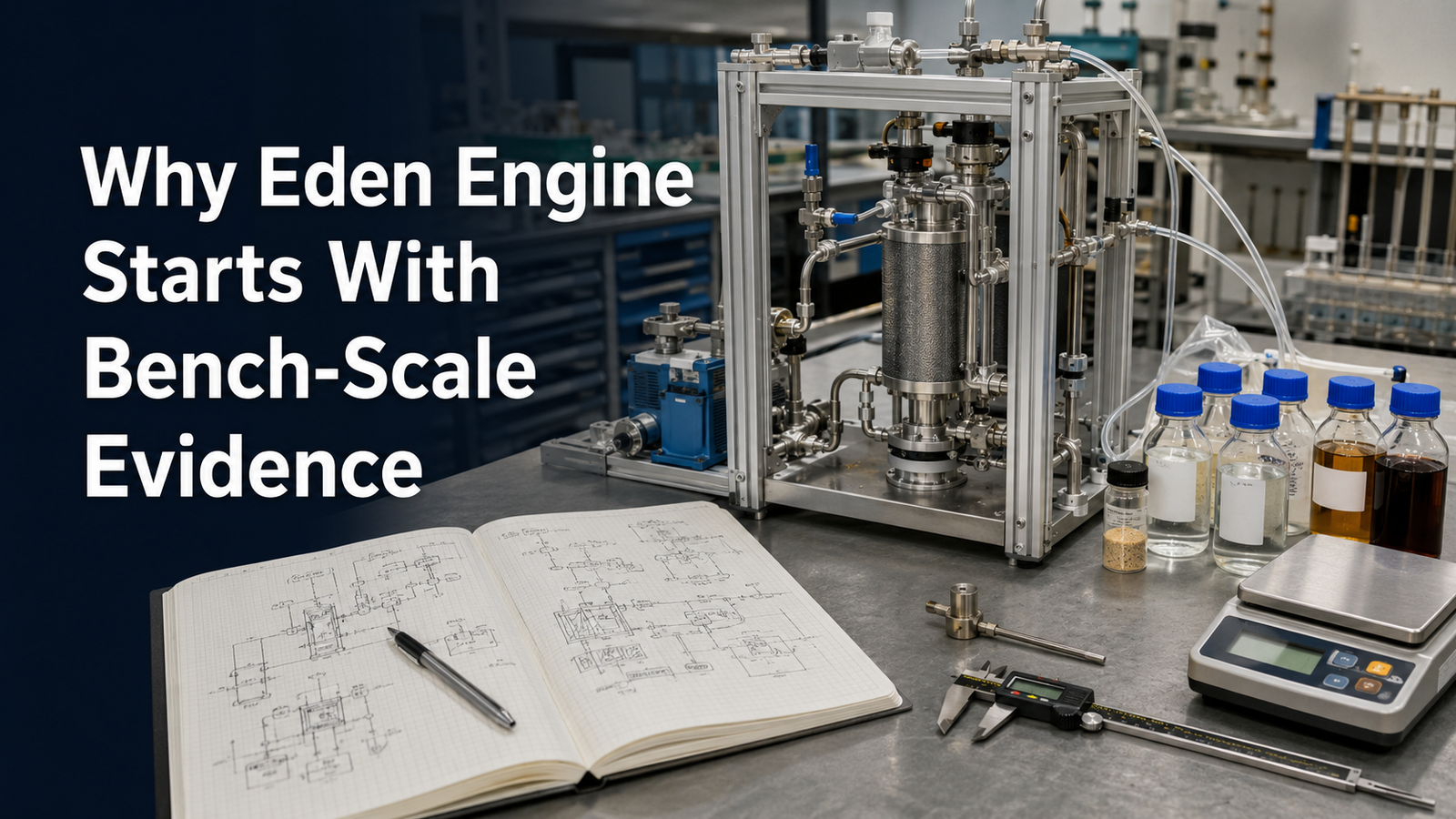
That is why Eden Engine starts with bench-scale evidence. Not as a branding exercise, and not as a way to suggest the system is already ready for deployment. Bench-scale work is the disciplined first step in learning whether a carbon conversion pathway can be measured, constrained, and improved without outrunning the evidence.
What Bench-Scale Evidence Actually Means
Bench-scale validation is the practice of testing a process at a small, controlled size before making claims about pilots, products, or infrastructure. For Eden Engine, that means focusing on the fundamentals: what enters the system, what leaves it, what is measured along the way, and which assumptions still need to be tested.
The point is not to make the setup look impressive. The point is to make the setup legible. A credible bench program should be able to describe its reactor boundary, input streams, sampling plan, sensor placement, measurement limits, and failure modes. It should make uncertainty visible instead of hiding it behind optimistic language.
Why This Matters for Carbon-to-Food Research
Carbon-to-food concepts can attract attention quickly because the long-term implications are so large: climate resilience, food security, land-independent production, and closed-loop resource systems. That attention creates a responsibility to communicate carefully.
Eden Engine should not claim commercial readiness, current food production, performance results, or nutritional outcomes unless those facts are supported by supplied evidence. The better path is slower and stronger: define a bounded technical target, test one part of the system at a time, and let each result determine the next question.
The Evidence Package Eden Engine Needs First
A useful early evidence package is not a glossy promise of a finished food system. It is a technical record that helps reviewers understand how the work is being staged. For Eden Engine, that package should focus on a few practical questions:
- Which carbon input is being considered, and how is it characterized?
- What intermediate or bounded carbohydrate target is being evaluated?
- How are mass balance, water use, energy use, and process losses tracked?
- Which sensors are necessary, and where do their limits begin?
- What would count as a meaningful next milestone without implying commercial readiness?
These questions are intentionally plain. They are also exactly the kind of questions grant reviewers, technical advisors, and early partners need answered before they can take a platform seriously.
Why Small Tests Are Not Small Ambition
Starting small does not mean thinking small. It means respecting the order in which technical credibility is built. A compact reactor, a clear measurement plan, and a conservative milestone can do more for Eden Engine than broad claims about future abundance.
Small tests also make the system easier to challenge. That matters. A platform intended to operate in food security or closed-loop environments must be designed for scrutiny from the beginning. If an assumption cannot survive a small test, it should not be carried into a larger one.
A More Credible Path Forward
The strongest version of Eden Engine is not a story about instant food from air. It is a staged engineering program for exploring whether controlled carbon conversion can become part of a future food-system architecture. That program should be transparent about what is known, what is unknown, and what must be demonstrated next.
Bench-scale evidence is where that discipline begins. It gives Eden Engine a way to move from thesis to test, from test to learning, and from learning to a more defensible roadmap. In a field where hype is easy, restraint is not weakness. It is the foundation of trust.