

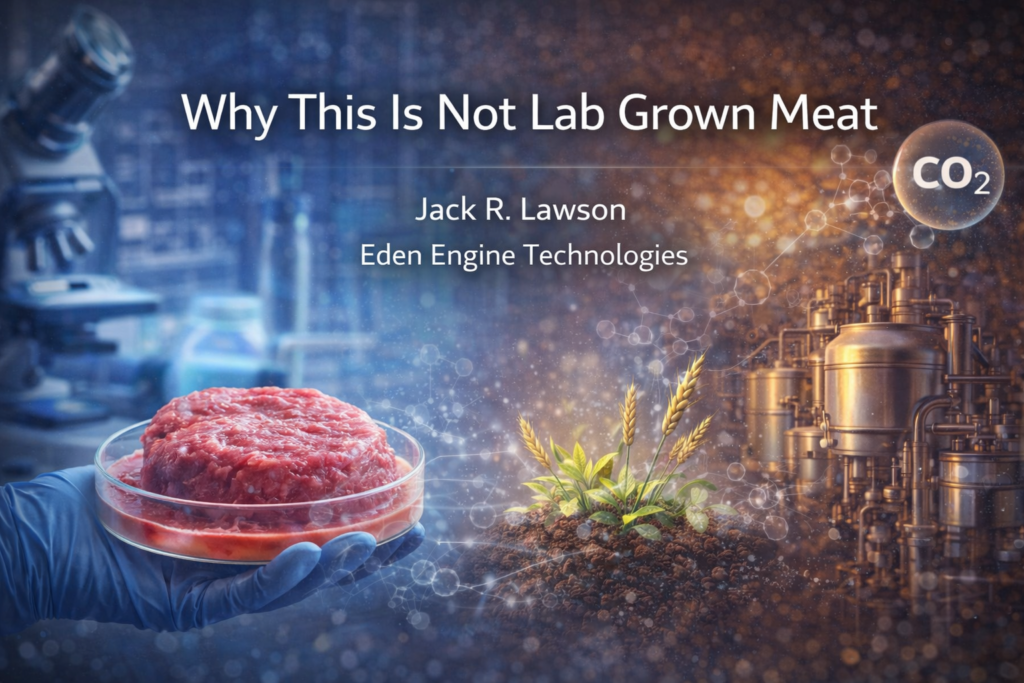
When people first hear about converting CO₂ into food, they often jump to a familiar phrase.
Lab grown meat.
It is understandable. Both ideas involve technology. Both move food production away from traditional farms. Both challenge long held assumptions about how nutrition is made.
But they are not the same thing.
Not scientifically. Not structurally. Not strategically.
Lab Grown Meat Replicates Animal Tissue
Lab grown meat, more accurately called cultivated meat or cellular agriculture, focuses on growing animal cells outside the body.
It starts with real animal cells. Those cells are placed into nutrient rich growth media. The goal is to replicate muscle tissue by encouraging the cells to divide and organize into structures similar to meat.
It is an attempt to reproduce an existing biological product without raising or slaughtering animals.
The end goal is still meat.
Carbon to Food Systems Start at the Molecular Level
Carbon to food systems do something fundamentally different.
They do not begin with animal cells. They do not attempt to recreate muscle tissue. They do not aim to replicate steak.
They begin with carbon dioxide.
The focus is on producing foundational food molecules, such as sugars, from captured CO₂ using controlled electrochemical and biochemical processes.
These molecules are not imitations. They are chemically identical to sugars already consumed every day.
This is not tissue engineering.
It is molecular conversion.
The Strategic Difference
Lab grown meat seeks to replace a specific product category.
Carbon based food systems seek to build foundational infrastructure.
Meat is one product.
Sugar is a platform molecule.
Sugars are used in:
- Direct human nutrition
- Fermentation processes
- Animal feed
- Industrial food manufacturing
- Biomaterial production
Starting with a foundational molecule creates flexibility.
It allows food systems to scale gradually rather than attempting to replicate complex biological structures immediately.
The Public Perception Gap
Lab grown meat has faced cultural resistance.
Some people worry about artificiality. Others question safety. Others simply prefer traditional agriculture.
Carbon to sugar systems operate differently.
They produce molecules already understood, already regulated, and already central to human metabolism.
There is no novel tissue structure. No attempt to simulate animal muscle fibers. No replacement of a culturally symbolic food.
The product is familiar.
The system is what changes.
Why Starting With Sugar Matters
Sugar is one of the most studied molecules in human nutrition.
Its structure, metabolism, safety profile, and regulatory frameworks are deeply established.
Beginning at the molecular foundation allows innovation to move step by step.
Instead of asking society to immediately accept engineered steak, the focus is on producing a well understood ingredient through a cleaner and more resilient method.
Infrastructure first.
Complexity later.
This Is About Resilience, Not Replacement
Lab grown meat often enters the conversation framed as a replacement for livestock.
Carbon to food systems are framed differently.
They are about resilience.
They are about decoupling calories from farmland.
They are about local production in cities, deserts, remote regions, and eventually space habitats.
They are about stability in a world facing climate volatility and supply chain disruption.
The Bottom Line
Lab grown meat replicates animal tissue.
Carbon to food systems convert atmospheric carbon into foundational nutrition molecules.
One is cellular agriculture.
The other is carbon conversion infrastructure.
They operate at different biological layers.
They solve different strategic problems.
They represent different visions of how food evolves.
Understanding that difference is critical.
Because the future of food is not a single technology.
It is a layered system.
And carbon based nutrition is not lab grown meat.
Jack R Lawson, Founder, Eden Engine Technologies