For most of human history, food has been inseparable from land.
Calories have come from soil, seasons, weather, water availability, and supply chains that stretch from farms to cities. Civilization itself grew around this constraint. Where food could be produced, people could live. Where it could not, societies struggled.
But agriculture has always been a workaround, not a fundamental solution.
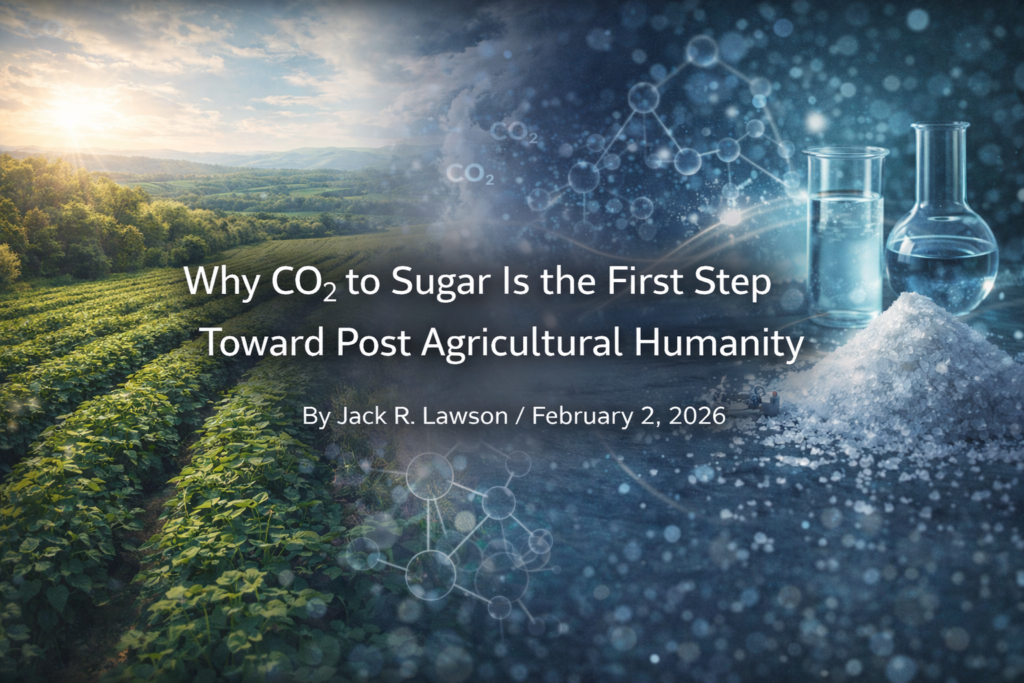
At its core, food is chemistry and biology. Carbon, hydrogen, oxygen, nitrogen, energy, and time. Plants use sunlight to turn CO₂ into sugar. Everything else in the food chain builds on that first step.
Sugar is not just something we eat. It is the base molecule that powers growth, fermentation, protein production, fats, vitamins, and cellular structure. It is the metabolic currency of life.
If you can control sugar production, you can control food production.
That is why CO₂ to sugar matters so much. It represents a break from the idea that food must begin in fields.
Agriculture is a dependency, not a requirement
Modern agriculture is incredibly productive, but it is also fragile. It depends on land, water, fertilizer, stable climate patterns, transportation networks, and large energy inputs. When any of those fail, food systems strain quickly.
This is not a failure of farming. It is a limitation of land based systems.
Post agricultural does not mean anti agriculture. It means agriculture is no longer the only way food can exist. It means nutrition is no longer hostage to acreage, rainfall, or geography.
A post agricultural food system begins upstream of farms. It begins at carbon.
Why sugar comes first
No one eats sugar by itself and that is precisely the point.
Sugar is an input, not an endpoint. It feeds fermentation systems. It enables microbial protein production. It supports the creation of fats, fibers, and micronutrients. It allows structured foods to be grown instead of harvested.
If Phase 2 is food, Phase 1 must be sugar.
Trying to jump directly to finished food without controlling sugar is like trying to build a city without power generation. It may look impressive in a demo, but it fails under real conditions.
CO₂ to sugar establishes a stable biological foundation that everything else can plug into.
Decoupling food from land and seasons
Once sugar can be made from captured CO₂ using clean energy, food production becomes modular.
Cities can host nutrition systems without importing calories from thousands of miles away. Harsh environments can produce food without arable land. Disaster zones can rebuild nutrition capacity without waiting for crops to grow.
Food becomes something you manufacture reliably instead of something you hope survives the next season.
This is the quiet shift toward post agriculture.
A different relationship with the planet
Post agricultural does not mean abandoning the Earth. It means relieving pressure on it.
When calories no longer require millions of acres, land can return to ecosystems. Forests, wetlands, and biodiversity can recover. Water use drops. Fertilizer runoff declines. Emissions tied to land conversion fall.
Food production stops competing with nature and starts cooperating with it.
CO₂ becomes feedstock instead of waste.
The long path forward
This transition does not happen overnight. It happens in phases.
Phase 1 proves carbon can reliably become sugar. Phase 2 turns sugar into real food. Phase 3 scales systems responsibly. Phase 4 integrates them broadly.
Each step builds on the last.
Post agricultural humanity is not a single invention. It is a sequence of foundations laid carefully, one after another.
CO₂ to sugar is the first brick. Everything else depends on it.
Jack R. Lawson
Founder, Eden Engine Technologies Inc.