Sugar is rarely thought of as infrastructure. For most people, it is simply an ingredient on a label or something to limit in a diet. But beneath that surface understanding, sugar plays a far more foundational role in everyday life.
It supports food production, fermentation, pharmaceuticals, manufacturing, and many of the systems people rely on without ever noticing. When sugar becomes scarce, expensive, or disrupted, those impacts ripple outward quickly.
Abundant, clean sugar changes that equation.
Stability instead of volatility
Today, sugar prices fluctuate based on weather, crop yields, labor availability, and global trade. These swings affect not only food costs but also products that depend on biological processes.
When sugar can be produced reliably through controlled systems, supply becomes predictable. That stability reduces price volatility and shields everyday consumers from disruptions they did not cause.
For households, this means fewer sudden cost increases and more reliable access to essential goods.
Resilience in local communities
Many communities are dependent on long supply chains for basic food inputs. When transportation systems fail or global trade slows, shelves empty quickly.
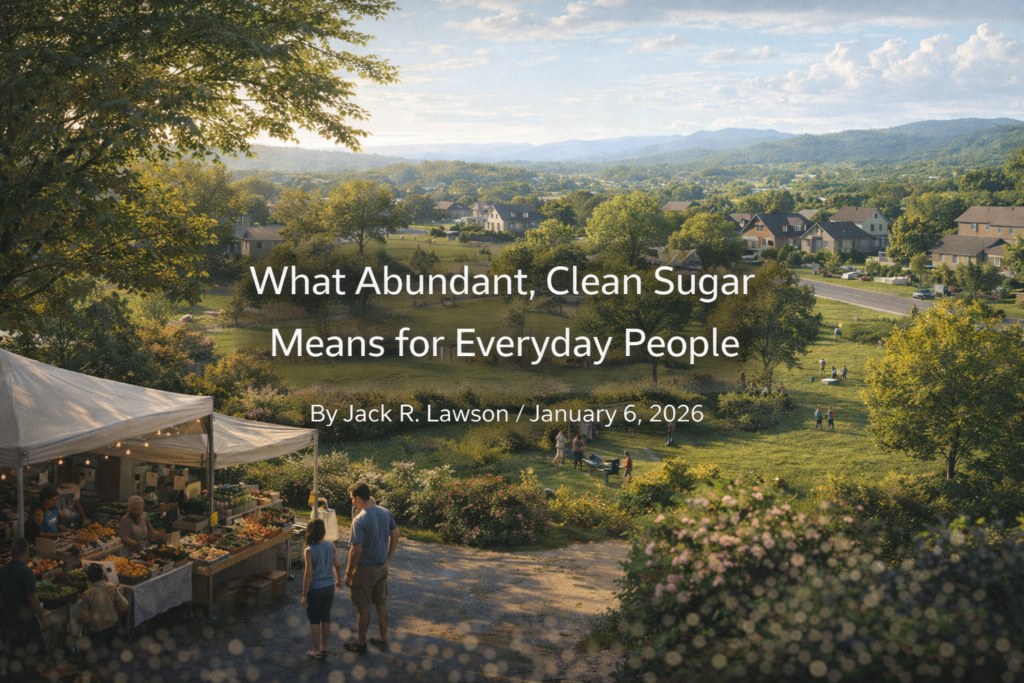
Local production of foundational inputs like sugar allows communities to maintain access to nutrition even during disruptions. This does not eliminate agriculture or trade, but it adds resilience where it is currently missing.
For everyday people, resilience means fewer shortages and less uncertainty.
Cleaner inputs, healthier systems
Conventional sugar production carries hidden environmental costs. Land conversion, water use, fertilizer runoff, and transportation emissions all affect air, water, and ecosystems that people live near.
Producing sugar from captured CO₂, water, and clean energy reduces these impacts at the source. Cleaner inputs lead to cleaner downstream systems.
Over time, this contributes to healthier environments and communities.
Lower pressure on land and resources
When foundational food inputs no longer require vast amounts of farmland, pressure on land begins to ease. Ecosystems gain space to recover, water systems stabilize, and competition for resources decreases.
For everyday people, this shows up indirectly through better air quality, more stable water supplies, and healthier natural surroundings.
Quiet changes with broad impact
Abundant, clean sugar does not look dramatic in daily life. It does not announce itself.
Instead, it quietly improves reliability. Food systems become steadier. Prices become less volatile. Environmental pressure eases. Communities gain resilience without needing to change how they live day to day.
These are the kinds of changes that matter most to everyday people.
Infrastructure people can rely on
When foundational inputs are produced cleanly and reliably, entire systems become easier to trust.
Abundant sugar is not about excess. It is about removing unnecessary fragility from the systems people depend on every day.
Jack R. Lawson
Founder, Eden Engine Technologies Inc.