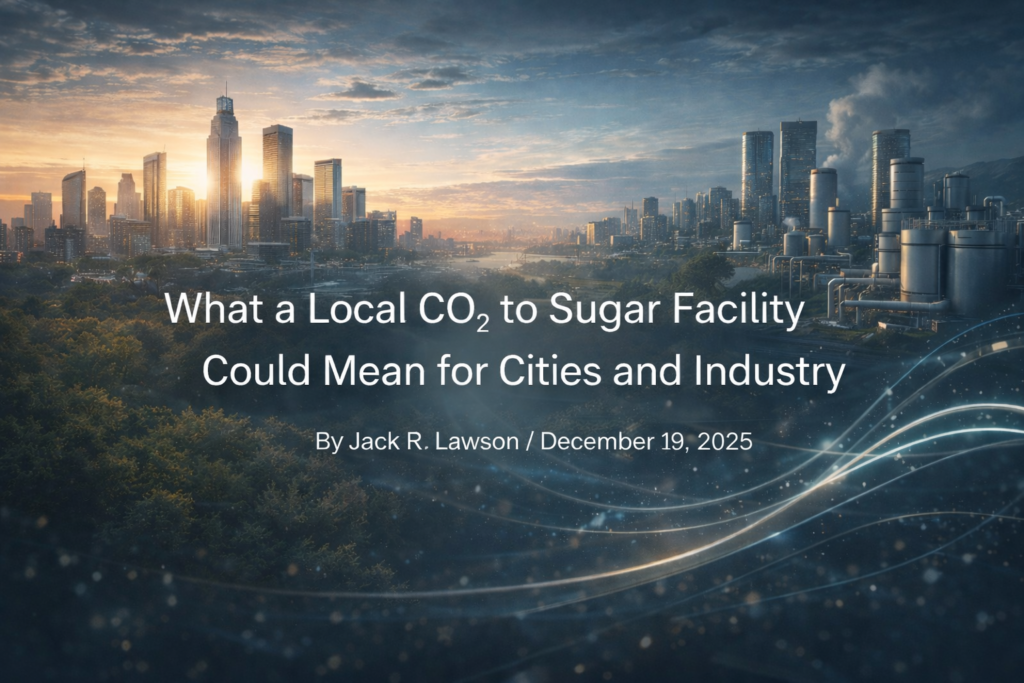
Modern cities and industrial centers produce enormous amounts of carbon dioxide. Power generation, manufacturing, cement production, waste processing, and transportation all contribute to concentrated CO₂ emissions that are typically treated as a liability.
But what if those same emissions became a local input for food and material systems instead of waste?
A local CO₂ to sugar facility represents a fundamentally different way of thinking about urban infrastructure. Rather than exporting emissions or offsetting them elsewhere, carbon becomes a feedstock that stays within the local economy.
From emissions to inputs
Sugar is one of the most versatile molecules in biology and industry. It supports fermentation, nutrient production, biochemical manufacturing, and food systems at nearly every scale.
Today, sugar production is tied to land, water availability, climate stability, and global logistics. These dependencies introduce fragility into systems that cities and industries rely on every day.
A local CO₂ to sugar facility changes that equation by decoupling sugar production from farmland and seasons. Carbon dioxide, water, and clean energy become the primary inputs instead.
Implications for cities
For cities, localized carbon conversion offers several structural advantages.
- Reduced reliance on long supply chains for basic nutritional and industrial inputs
- New pathways for emissions reduction without exporting problems elsewhere
- Improved resilience during disruptions to food, energy, or transportation systems
- Opportunities to integrate food and material production into existing infrastructure
Instead of treating carbon management as a cost center, cities can begin to view it as a productive asset.
Implications for industry
Industrial facilities already operate in environments where carbon capture, heat management, and energy flows are well understood. This makes them natural candidates for early deployment of closed loop conversion systems.
A local sugar output can support multiple downstream uses including fermentation based manufacturing, specialty chemicals, materials, and eventually structured food systems.
By producing these inputs on site or nearby, industries reduce exposure to price volatility, logistics delays, and resource constraints that increasingly affect global supply chains.
Why localization matters
Centralized systems are efficient under ideal conditions but fragile under stress. Localized systems trade some economies of scale for adaptability, resilience, and control.
A distributed network of CO₂ to sugar facilities allows production to happen closer to where resources are used, waste is generated, and demand exists.
This approach does not replace agriculture or global trade. It complements them by removing pressure from land, ecosystems, and logistics networks where alternatives exist.
A foundation for future systems
In the Eden Engine framework, sugar is a foundational input. Once produced reliably, it enables higher level systems including nutrient synthesis, structured food growth, and biological manufacturing.
Local CO₂ to sugar facilities represent the first practical layer of this architecture. They create a stable, scalable base that other systems can build on over time.
The long term impact is not just cleaner cities or more efficient industry. It is a shift in how we design infrastructure around carbon, food, and resilience.
When basic inputs can be produced locally from air, water, and energy, entirely new possibilities emerge.
Jack Lawson
Founder, Eden Engine Technologies Inc.