Most conversations about future food systems focus on the end result. Meals, ingredients, and finished products. Far less attention is paid to the layers beneath those outcomes, where the real constraints exist.
CO₂ derived nutrition begins at that foundational level. It does not start with food. It starts with inputs.
Understanding how those inputs evolve into full foods is essential to understanding where this technology can realistically go and how long that transition takes.
From carbon to nutrition
Carbon dioxide is abundant, predictable, and globally distributed. For decades, it has been treated primarily as a waste stream. CO₂ derived nutrition reframes it as a raw material.
The first step in that transformation is converting carbon into biologically useful molecules. In the Eden Engine, this begins with sugar.
Sugar is not the goal. It is the bridge. It represents the point where carbon becomes usable by biological systems in a controlled and repeatable way.
Why sugar comes first
Sugar sits at the center of nearly every food and biological manufacturing process. It fuels fermentation, supports protein and fat production, and provides the energy backbone for cellular growth.
By focusing first on sugar, CO₂ derived systems establish a stable, measurable foundation. This allows engineers and researchers to evaluate efficiency, energy balance, and system reliability before introducing additional biological complexity.
Without a dependable sugar layer, higher order food production cannot scale.
The transition from inputs to food
Full foods do not appear suddenly. They emerge through layers of processing and biological conversion.
Once sugar is available as a consistent input, it can feed systems that produce amino acids, lipids, fibers, and micronutrients. These components are then assembled into nutritionally complete foods using fermentation, cellular growth, and structured processing techniques.
This phase is where human impact becomes direct. Meals replace molecules. Nutrition replaces inputs.
Why this progression matters
Skipping steps in food system design often leads to failure. Biological systems are sensitive, complex, and tightly coupled to their inputs.
Building from carbon to sugar to full foods allows each layer to be tested, validated, and improved independently. Problems are identified early, before they propagate through the entire system.
This staged approach also creates flexibility. Different regions, communities, and use cases may require different end products, even if they share the same foundational inputs.
What the future looks like
The future of CO₂ derived nutrition is not a single factory or product. It is a platform.
A platform where carbon, water, and energy can be converted into food wherever it is needed. A platform that complements agriculture rather than replaces it. A platform that reduces pressure on land, water, and ecosystems while increasing resilience.
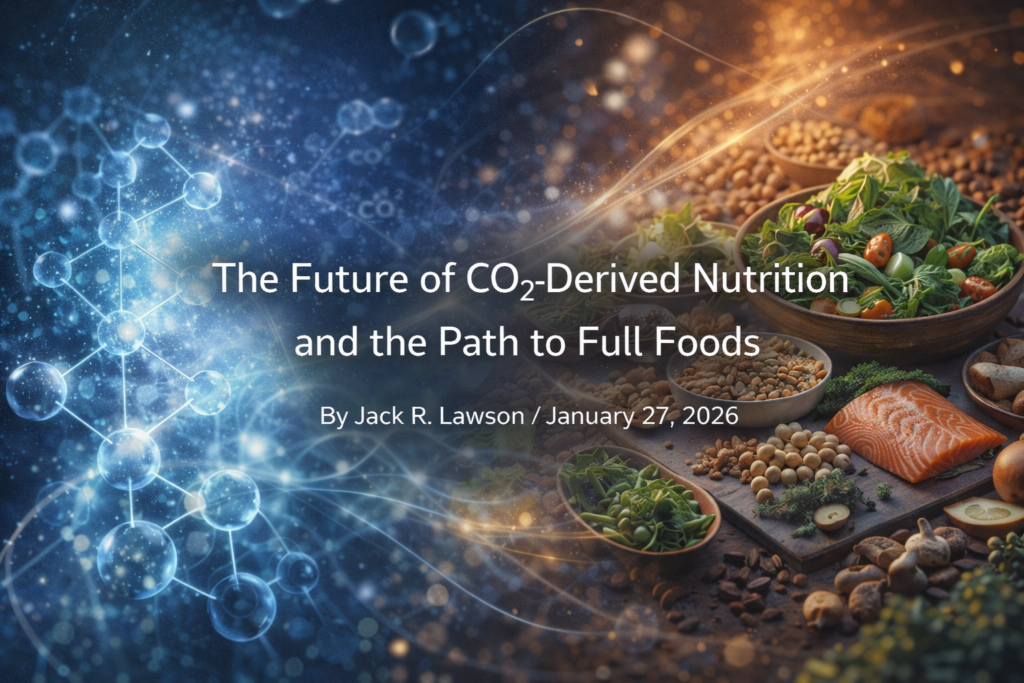
Full foods are the destination. Foundational molecules are the path.
A realistic timeline
Moving from carbon to meals is not instantaneous. It requires careful engineering, biological validation, and real world testing.
The near term focus is on proving that each layer works as intended. The long term outcome is a food system that is more flexible, more local, and less constrained by geography and climate.
That progression is deliberate by design.
Jack R. Lawson
Founder, Eden Engine Technologies Inc.