Every complex system begins with a simple question. For the Eden Engine, that question is whether carbon dioxide can be reliably transformed into a biological input that food systems already know how to use.
Phase 1 is where that question is tested.
This phase does not attempt to produce full foods. It focuses on building and validating the foundational layer that makes later phases possible.
Why Phase 1 matters
Many future food concepts fail because they attempt to solve too many problems at once. Biological systems are complex, sensitive, and tightly coupled to their inputs.
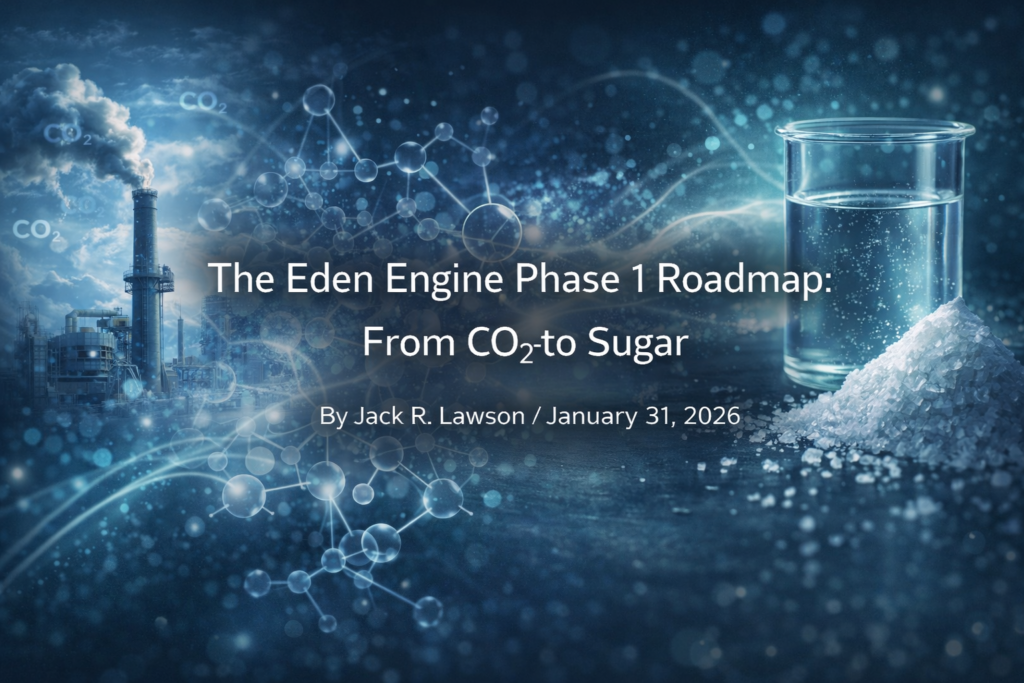
Phase 1 isolates the most critical transformation in the entire system. Converting CO₂ into sugar in a controlled, repeatable way.
Sugar is chosen not because it is a finished product, but because it is a universal biological input. Nearly every food manufacturing pathway depends on it.
The Phase 1 objective
The goal of Phase 1 is simple in description but challenging in execution.
Produce clean, consistent sugar from captured CO₂ using systems that can be measured, tested, and improved over time.
Success is not defined by volume. It is defined by reliability, efficiency, and understanding where the true constraints exist.
Step one: Carbon capture and preparation
Phase 1 begins with capturing carbon dioxide from available sources. This can include ambient air or concentrated exhaust streams.
The captured CO₂ must be conditioned to meet the requirements of downstream processes. Purity, pressure, and consistency all matter at this stage.
This step determines the stability of everything that follows.
Step two: Conversion into usable sugar
Once prepared, CO₂ is transformed into sugar through controlled biochemical and electrochemical pathways. This is the core technical challenge of Phase 1.
The focus here is not novelty. It is control.
Each reaction pathway is evaluated for yield, energy input, byproducts, and long term stability. Phase 1 is where models meet physical reality.
Step three: Validation and iteration
Producing sugar once is not enough. Phase 1 is about repeatability.
Systems are tested across operating conditions to identify failure points, inefficiencies, and limits. Data from these tests feeds directly back into system design.
Iteration is expected. Learning is the outcome.
What Phase 1 does not attempt
Phase 1 does not attempt to solve full nutrition, food texture, or consumer products.
Those challenges belong to later phases, once the foundational layer has been proven.
Attempting to move faster than this sequence introduces unnecessary risk.
How Phase 1 enables everything else
Once sugar can be produced reliably from CO₂, Phase 2 becomes possible.
Sugar feeds fermentation systems, protein production, fat synthesis, and structured food manufacturing. Without a stable sugar layer, those systems cannot operate predictably.
Phase 1 is the hinge point between concept and food.
A deliberate path forward
The Eden Engine roadmap is intentionally staged. Each phase reduces uncertainty before moving to the next.
Phase 1 is about earning confidence through evidence. The results of this phase determine how and when the system progresses.
This approach is slower on paper, but faster in practice.
Jack R. Lawson
Founder, Eden Engine Technologies Inc.