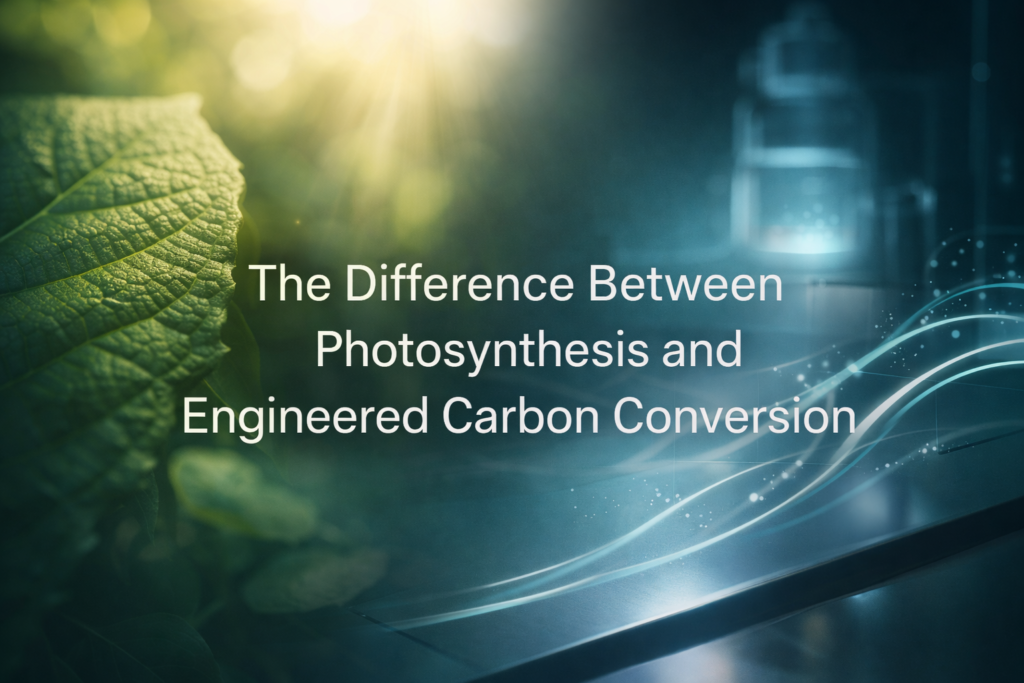
Photosynthesis is one of the most important processes on Earth. It powers nearly all life by converting carbon dioxide, water, and sunlight into sugar and oxygen. Every plant, crop, and ecosystem ultimately depends on it.
As interest grows in new ways to produce food and materials, a natural question arises: how does engineered carbon conversion differ from photosynthesis, and why would we ever need both?
How photosynthesis works
Photosynthesis is a biological process that takes place inside living cells. Plants capture sunlight using chlorophyll, then use that energy to convert carbon dioxide and water into simple sugars.
Those sugars fuel plant growth and serve as the base of the food chain. Over billions of years, this process has shaped Earth’s atmosphere, ecosystems, and agriculture.
Photosynthesis is elegant, self sustaining, and deeply integrated into natural systems. But it also comes with inherent constraints.
The constraints of natural systems
Photosynthesis depends on sunlight, land, water, climate, and growing seasons. It operates at the pace biology allows and within the limits of ecosystems.
For most of human history, those limits were acceptable. Today, global food systems face new pressures. Population growth, climate volatility, land degradation, and fragile supply chains are pushing traditional agriculture closer to its limits.
Photosynthesis cannot be sped up arbitrarily, relocated easily, or decoupled from geography.
What engineered carbon conversion does differently
Engineered carbon conversion approaches the same chemical problem from a different angle. Instead of relying on living cells and sunlight, it uses controlled chemical, electrochemical, or enzymatic processes to reduce carbon dioxide into useful molecules.
The goal is not to mimic plants, but to isolate the most essential function they perform: turning carbon into usable building blocks.
By operating in controlled environments, engineered systems can function independently of weather, soil quality, or seasons.
Energy source matters
One of the key differences lies in the source of energy. Photosynthesis uses sunlight directly. Engineered systems can use electricity from a variety of sources, including renewables.
This flexibility allows carbon conversion to occur wherever clean energy is available, including urban environments, industrial sites, and remote locations.
Energy becomes a design variable rather than a natural constraint.
Control and consistency
Biological systems are adaptive but variable. Crop yields change with weather, pests, and environmental conditions.
Engineered systems are designed for consistency. Inputs and outputs can be measured precisely. Reaction conditions can be adjusted in real time. Performance can be evaluated quantitatively.
This level of control is especially valuable in early stage food and material production systems.
Not a replacement for nature
Engineered carbon conversion is not a replacement for photosynthesis. It does not eliminate the need for plants, ecosystems, or agriculture.
Instead, it complements natural systems by handling specific tasks more efficiently under certain conditions.
Just as desalination does not replace rivers, and batteries do not replace the sun, engineered carbon conversion expands the toolbox rather than replacing the foundation.
Why both systems matter
Photosynthesis will always remain central to life on Earth. It builds ecosystems, supports biodiversity, and sustains the natural world.
Engineered carbon conversion offers an additional path for producing essential molecules when land, water, or climate are limiting factors.
Together, these approaches allow food and material systems to become more resilient, flexible, and scalable.
A shift in perspective
The real difference between photosynthesis and engineered carbon conversion is not competition, but context.
Photosynthesis excels at growing living systems. Engineered conversion excels at producing specific outputs under controlled conditions.
Understanding that distinction allows both to coexist in a future where food, materials, and ecosystems must all thrive.
— Jack Lawson, Founder, Eden Engine Technologies Inc.