Modern food and industrial systems depend heavily on land, water, and energy. As global demand for calories and biological inputs grows, these dependencies place increasing pressure on ecosystems, infrastructure, and supply chains.
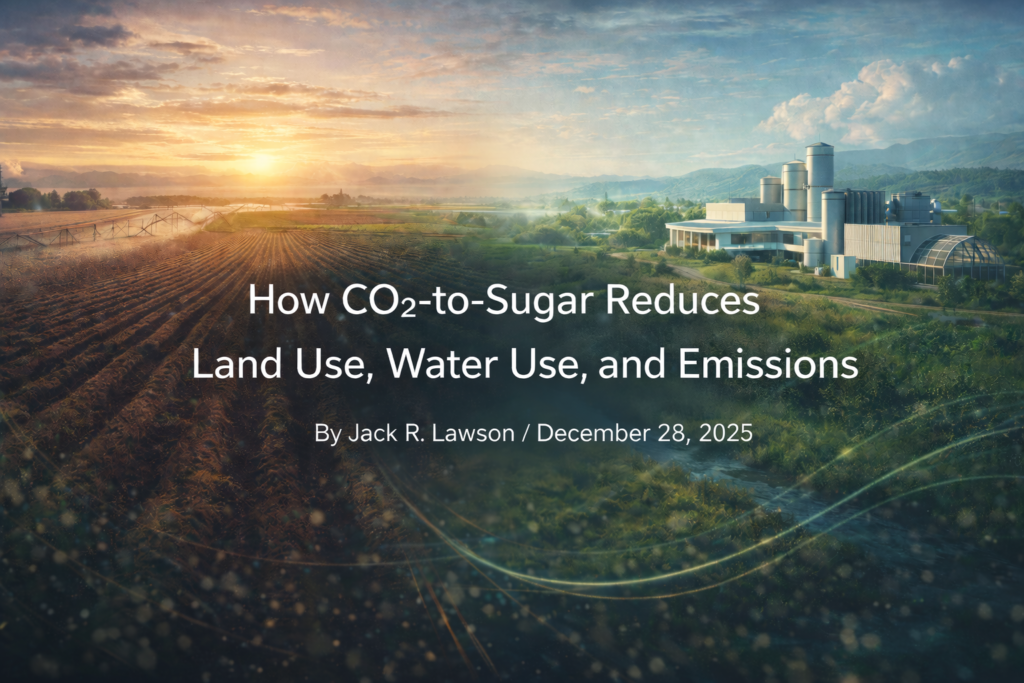
CO₂ to sugar systems offer a different approach. By producing foundational food and industrial inputs directly from captured carbon dioxide, water, and clean energy, these systems change the resource equation at its core.
Decoupling production from land
Traditional sugar production requires large tracts of arable land. Sugarcane and sugar beet cultivation compete directly with food crops, natural habitats, and expanding urban areas.
A CO₂ to sugar system does not rely on farmland. Production occurs inside controlled modules that can be located near industrial sites, cities, or regions unsuitable for agriculture.
This decoupling reduces pressure on land while opening opportunities for rewilding, ecosystem restoration, and alternative land use strategies that support biodiversity.
Reducing water demand
Agriculture is one of the largest consumers of freshwater globally. Sugar crops are particularly water intensive, especially in regions where irrigation is required to maintain yields.
CO₂ to sugar systems use water in closed or semi closed loops. Water inputs are measured, recycled, and reused rather than lost through evaporation, runoff, or soil absorption.
This approach dramatically lowers net water consumption compared to field based cultivation, especially in water stressed regions.
Lowering emissions through utilization
Conventional sugar production generates emissions through land clearing, fertilizer use, transportation, and processing. These emissions are spread across long supply chains and are difficult to manage as a whole.
CO₂ to sugar systems treat carbon dioxide as an input rather than waste. When paired with clean energy, captured CO₂ is converted into usable molecules instead of being released into the atmosphere.
This shifts emissions management from mitigation to utilization, reducing both direct and indirect carbon footprints.
Localized and resilient systems
Producing sugar locally reduces the need for long distance transportation and storage. This lowers fuel use, minimizes losses, and improves supply chain resilience during disruptions.
Local production also allows systems to be scaled to demand, reducing overproduction and waste associated with centralized commodity markets.
A foundation for sustainable growth
Sugar is a foundational molecule. Once produced reliably, it enables downstream systems such as fermentation, nutrient synthesis, biological manufacturing, and eventually structured food production.
By reducing land use, water use, and emissions at the input level, CO₂ to sugar systems support sustainable growth without expanding the environmental footprint of food and industry.
The result is not simply a cleaner process. It is a shift toward infrastructure designed around efficiency, resilience, and long term ecological balance.
Jack R. Lawson
Founder, Eden Engine Technologies Inc.