Food systems have always been energy systems. From sunlight captured by plants to fuel burned for fertilizer, transport, and processing, every calorie of food depends on energy flowing through a chain of transformations.
As global food demand increases and environmental constraints tighten, the energy sources powering food production matter more than ever.
Clean energy is not just an environmental upgrade. It is a structural unlock for entirely new ways of producing nutrition.
The hidden energy cost of modern food
Today’s food systems rely heavily on fossil energy, often in indirect ways. Fuel powers farm equipment. Natural gas produces fertilizer. Electricity runs irrigation, refrigeration, processing, and transport.
These inputs are distributed across long supply chains, making food production vulnerable to price shocks, disruptions, and emissions constraints.
As a result, the true energy footprint of food is far larger than most consumers realize.
Why energy constraints limit innovation
Traditional agriculture is tied to sunlight, seasons, and geography. While those constraints shaped civilization, they also limit how quickly food systems can adapt.
Advanced food technologies often struggle not because the chemistry is impossible, but because energy inputs are too expensive, too variable, or too carbon intensive.
Without abundant clean energy, many promising food system innovations remain theoretical.
Clean energy changes the equation
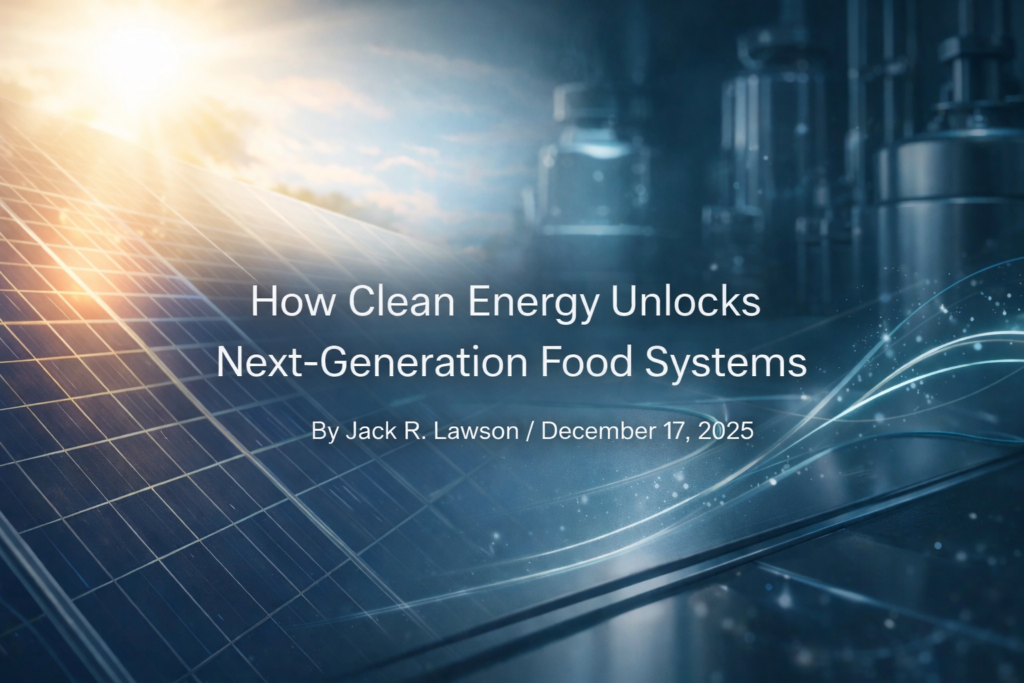
Clean energy allows food production to decouple from traditional constraints. When electricity becomes abundant, predictable, and low emission, it can directly power processes that previously depended on biology alone.
This includes controlled chemical, electrochemical, and enzymatic pathways that convert simple inputs into usable food molecules.
Energy becomes a controllable variable rather than a limiting factor.
From sunlight to electrons
Photosynthesis captures energy as photons. Engineered systems capture energy as electrons.
This distinction matters. Electricity can be routed, stored, measured, and delivered with precision. It can be generated from many sources and used wherever infrastructure exists.
By shifting energy capture upstream, food systems gain flexibility without abandoning biological principles.
Why CO₂-to-sugar depends on clean energy
Converting carbon dioxide into sugar requires energy. The cleaner and more affordable that energy becomes, the more viable controlled carbon conversion becomes.
Clean energy allows CO₂-to-sugar systems to operate without shifting emissions elsewhere. It ensures that carbon is reused rather than relocated.
This alignment is essential for building food systems that are both scalable and responsible.
Local production powered by energy, not land
When energy is the primary input, food production no longer needs to be tied to farmland. Nutrition can be produced near cities, industrial sites, or regions with limited arable land.
This reduces transportation costs, strengthens resilience, and shortens supply chains.
Clean energy makes local production practical rather than aspirational.
Reliability over variability
Weather driven systems are inherently variable. Energy driven systems can be designed for consistency.
Clean energy paired with controlled food production enables predictable output regardless of season or climate.
This reliability is critical for long term planning, food security, and infrastructure development.
Scaling with intention
Next generation food systems must scale without amplifying environmental harm. Clean energy provides the foundation for growth without repeating past tradeoffs.
Instead of expanding land use or extracting more resources, systems can scale by improving efficiency and deploying additional energy capacity.
This shifts food system growth from extractive expansion to engineered optimization.
The path forward
Clean energy alone does not solve food challenges. But without it, many solutions remain out of reach.
By pairing clean energy with controlled carbon conversion and modular food production, it becomes possible to build systems that are resilient, scalable, and adaptable.
Next generation food systems will not replace agriculture. They will extend it, stabilize it, and reduce pressure on the natural world.
Clean energy is the key that unlocks that future.
— Jack Lawson, Founder, Eden Engine Technologies Inc.