

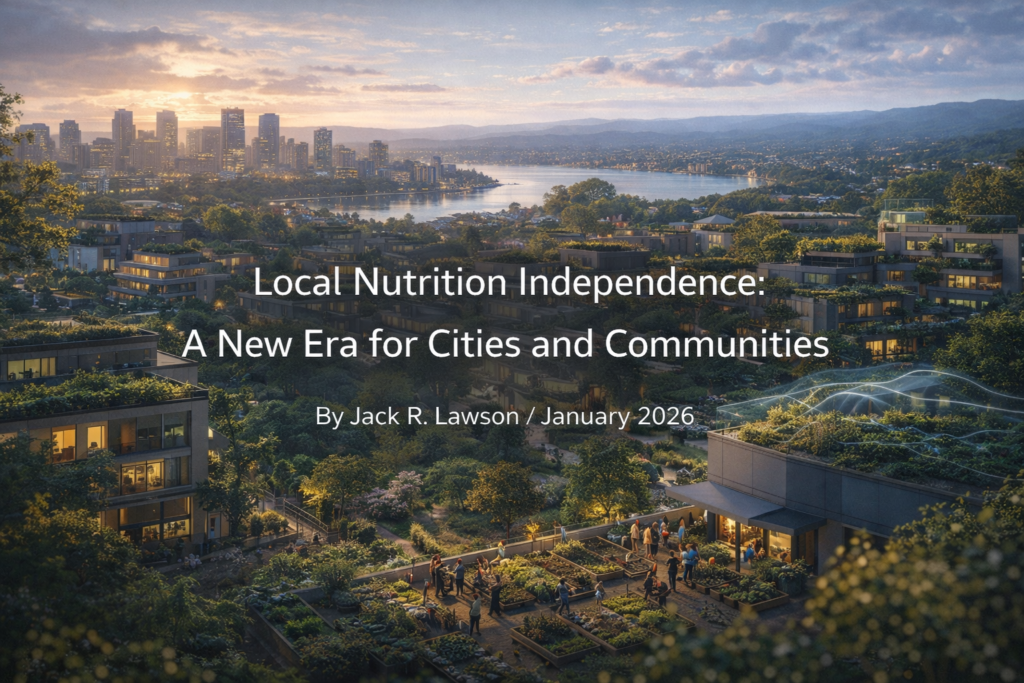
Modern cities are deeply interconnected, efficient, and fragile at the same time. Food arrives through complex supply chains that stretch across regions, borders, and oceans. When those systems function normally, the process is invisible. When they break, the consequences are immediate.
Local nutrition independence is about changing that relationship. Not by isolating communities from global trade, but by giving them the ability to produce foundational nutrition locally when external systems fail or become unreliable.
From dependence to optionality
Most cities do not produce the calories they consume. They import them. This creates efficiency, but it also creates dependency on transportation, fuel, weather patterns, labor availability, and geopolitical stability.
Nutrition independence does not mean cities must grow all their food within their borders. It means they have options. The ability to produce core nutritional inputs locally reduces risk without eliminating participation in broader food systems.
Optionality is resilience.
Foundational inputs matter more than finished food
Food systems are often discussed in terms of crops and meals. In reality, they are built on a small number of foundational inputs that enable everything else.
Clean sugar is one of those inputs. It supports fermentation, protein production, nutrient synthesis, and structured food manufacturing. When that foundation is stable, food systems become easier to operate, adapt, and scale.
Local production of foundational inputs allows communities to manufacture food rather than wait for it to arrive.
Cities as producers, not just consumers
Cities generate enormous amounts of carbon dioxide, waste heat, and unused energy. Traditionally, these outputs are treated as problems to manage.
Nutrition independence reframes them as inputs.
By converting captured CO₂ into usable biological inputs, cities can support food manufacturing systems within their own infrastructure. This does not replace farms. It complements them and reduces pressure on land, water, and rural supply chains.
Urban food production becomes cleaner, more controlled, and more predictable.
Community scale resilience
Local nutrition systems are not limited to megacities. Smaller communities, remote towns, and industrial hubs all face similar vulnerabilities.
Community scale systems can support:
- Emergency shelters and hospitals
- Schools and public institutions
- Remote or isolated populations
- Industrial campuses and research centers
When nutrition can be produced close to where it is consumed, communities recover faster from disruption and experience fewer cascading failures.
Stability without isolation
Nutrition independence is not about retreating from global systems. It is about strengthening them by reducing single points of failure.
Communities that can meet a portion of their nutritional needs locally are better positioned to weather shortages, price spikes, and logistical disruptions. They remain connected, but no longer exposed.
A quiet but meaningful shift
The most important infrastructure changes are often invisible. People notice when systems fail, not when they quietly work.
Local nutrition independence does not change how people live day to day. It changes what happens when conditions are no longer ideal.
As cities and communities face increasing environmental, economic, and geopolitical uncertainty, the ability to produce foundational nutrition locally becomes less of an experiment and more of a necessity.
Jack R. Lawson
Founder, Eden Engine Technologies Inc.