
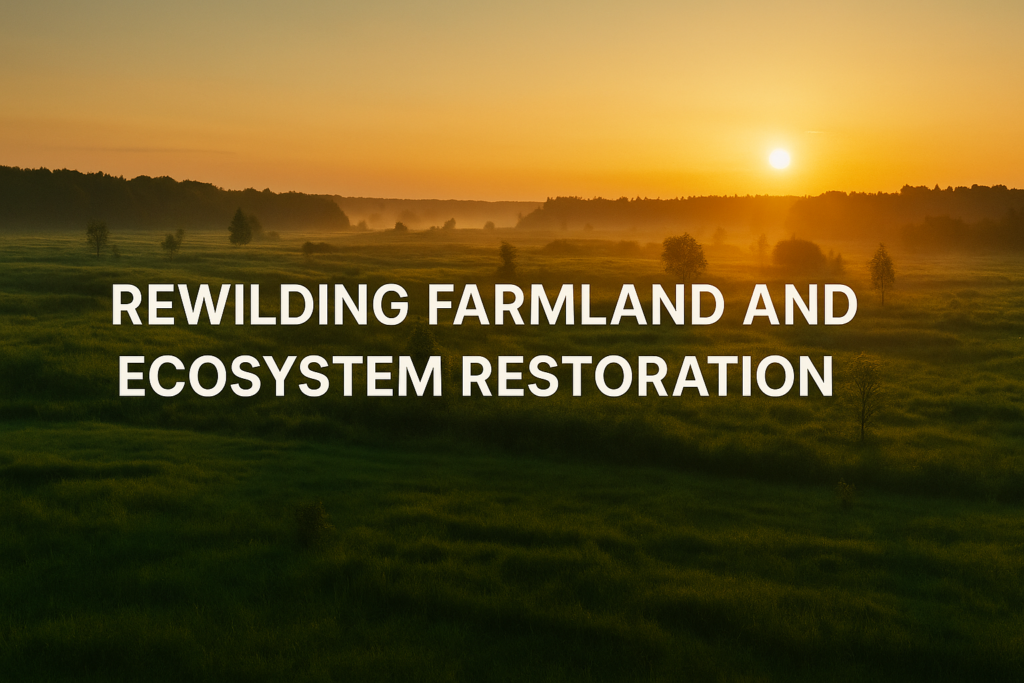
When food production needs less land, forests, wetlands, and wildlife can return.
For more than a century humanity has pushed farms into forests, grasslands, and wetlands. Fields replaced habitats. Hedgerows disappeared. Rivers were straightened and drained so that more land could be planted and harvested.
This expansion fed billions of people. It also came with a cost. Many ecosystems are now fragmented and stressed. Wild species have less space to live. Soils are tired and water cycles are disrupted.
Rewilding farmland is a different path. Instead of asking nature to give up more ground, we reduce the amount of land required for food. New food technologies make this possible. When calories and core ingredients are produced in compact systems, entire landscapes can slowly shift from crops back to living ecosystems.
What Rewilding Farmland Really Means
Rewilding is the process of allowing land to move back toward a more natural state. It does not always mean fencing off everything and walking away. It often means guiding land through a transition that favors native species, healthier soils, and stable water cycles.
- Removing or reducing intensive farming on selected areas
- Planting native trees, shrubs, and grasses where fields once stood
- Letting rivers meander and reconnect with floodplains
- Creating corridors so animals can move between habitats
None of this works at scale if people still need every acre to grow food. That is where new food systems and platforms like the Eden Engine enter the picture.
Why Our Food System Uses So Much Land
Modern agriculture is efficient compared to the past, yet it still depends on massive areas of land and water. Several forces drive this land hunger.
Low Conversion Efficiency
Sunlight hits fields with huge energy. Only a small fraction ends up stored in crops. Much of the potential is lost before food ever reaches a plate.
Monocultures And Inputs
Large fields of a single crop are easier to manage, yet they often require fertilizers, pesticides, and constant tillage. This slowly wears down local ecosystems.
Global Demand
As populations grow and diets shift, demand for calories and animal feed keeps rising. Forests and grasslands are often cleared to keep up.
If every calorie must pass through a field, the planet has limited room to heal. The question becomes simple. How do we meet human needs while freeing land for nature.
New Food Technologies That Free Up Land
A new generation of food technologies is emerging that does not rely on open fields. Instead, they use controlled environments and direct carbon conversion. Three broad categories matter for rewilding.
- Closed loop carbon to food platforms
Systems like the Eden Engine aim to transform captured carbon, water, and clean energy into core food molecules inside compact reactors. - Precision fermentation and cellular production
Microbes and cells can produce proteins, fats, and specialty ingredients in tanks, similar to brewing, with far less land than traditional crops or livestock. - Controlled environment agriculture
Vertical farms and advanced greenhouses use lighting, climate control, and efficient water recycling to grow crops in smaller footprints close to cities.
None of these approaches need millions of acres. They trade land area for technology and energy. When combined with clean power, they create food without constant pressure to clear more habitat.
What Happens When Farmland Returns To Nature
Rewilding is not just a visual change. It rewires how landscapes function. When fields are retired and restored, several important shifts occur.
- Carbon Storage
Trees, deep rooted grasses, and healthy soils store large amounts of carbon. Rewilded land can act as a long term carbon sink. - Biodiversity Recovery
Pollinators, birds, and mammals find new food and shelter. Complex food webs rebuild and stabilize. - Water And Flood Protection
Wetlands and forested areas hold water like a sponge. They reduce flood risk and improve water quality downstream. - Resilient Local Climates
Vegetation cools landscapes, improves humidity patterns, and makes surrounding regions more comfortable for people.
Rewilding does not erase human presence. It changes the balance so that natural systems have space to operate again.
Designing Food Systems That Heal Instead Of Consume
The real opportunity is not only to shrink farmland. It is to design food systems that actively support restoration. That means linking production choices with ecological outcomes from the beginning.
For example, a region could:
- Move a portion of calorie production into compact closed loop systems
- Target the most fragile or degraded farmland for early rewilding
- Use native tree planting and habitat corridors to reconnect landscapes
- Support farmers as they transition toward stewardship and new revenue models
The end result is a system where producing food and restoring ecosystems are not competing goals. They become parts of the same strategy.
How The Eden Engine Fits Into A Rewilded Future
The Eden Engine is designed for this kind of world. By focusing on compact, closed loop carbon to food systems, it aims to provide calories and core ingredients without demanding new farmland.
In the long range vision, Eden Engine units can sit beside food factories and city infrastructure, turning captured carbon into clean sugar and other essential molecules. As these systems scale, more land can be set aside for restoration rather than expansion.
Rewilding is a long process. It takes patience, planning, and trust in living systems. New food technologies give us an extra tool. They let humanity loosen its grip on fragile landscapes while still feeding everyone.
A world with rewilded farmland is not a return to the past. It is a future where advanced food systems and thriving ecosystems exist side by side.
Jack Lawson
Founder, Eden Engine Technologies Inc.